JUDGMENT OF THE COURT OF FIRST INSTANCE (Fifth Chamber)
10 June 2009 (*)
(Community trade mark – Opposition proceedings – Application for Community figurative mark milko ΔΕΛΤΑ – Earlier Community figurative mark MILKA – Relative ground for refusal – Likelihood of confusion – Similarity of the signs – Article 8(1)(b) of Regulation (EC) No 40/94 (now Article 8(1)(b) of Regulation (EC) No 207/2009)
In Case T‑204/06,
Vivartia ABEE Proïonton Diatrofis kai Ypiresion Estiasis, formerly Delta Protypos Viomichania Galaktos AE, established in Tavros (Greece), represented by P.-P. Kanellopoulos and V. Kanellopoulos, lawyers,
applicant,
v
Office for Harmonisation in the Internal Market (Trade Marks and Designs) (OHIM), represented by D. Botis, acting as Agent,
defendant,
the other party to the proceedings before the Board of Appeal of OHIM, intervener before the Court of First Instance, being
Kraft Foods Schweiz Holding AG, established in Zurich (Switzerland), represented by T. de Haan and P. Péters, lawyers,
ACTION brought against the decision of the Second Board of Appeal of OHIM of 8 June 2006 (Case R 540/2005-2) relating to opposition proceedings between Kraft Foods Schweiz Holding AG and Delta Protypos Viomichania Galaktos AE,
THE COURT OF FIRST INSTANCE OF THE EUROPEAN COMMUNITIES (Fifth Chamber),
composed of M. Vilaras, President, M. Prek (Rapporteur) and V.M. Ciucǎ, Judges,
Registrar: N. Rosner, Administrator,
having regard to the application lodged at the Registry of the Court of First Instance on 3 August 2006,
having regard to the response of OHIM lodged at the Registry of the Court on 4 December 2006,
having regard to the response of the intervener lodged at the Registry of the Court on 17 November 2006,
further to the hearing on 22 January 2009,
gives the following
Judgment
Background to the dispute
1 On 22 January 2002, the applicant, Delta Protypos Viomichania Galaktos AE, now known as Vivartia ABEE Proïonton Diatrofis kai Ypiresion Estiasis, filed an application for a Community trade mark at the Office for Harmonisation in the Internal Market (Trade Marks and Designs) (OHIM) under Council Regulation (EC) No 40/94 of 20 December 1993 on the Community trade mark (OJ 1994 L 11, p. 1) as amended (replaced by Council Regulation (EC) No 207/2009 of 26 February 2009 on the Community trade mark (OJ 2009 L 78, p. 1)).
2 The mark in respect of which registration was sought is the following figurative sign in colour:
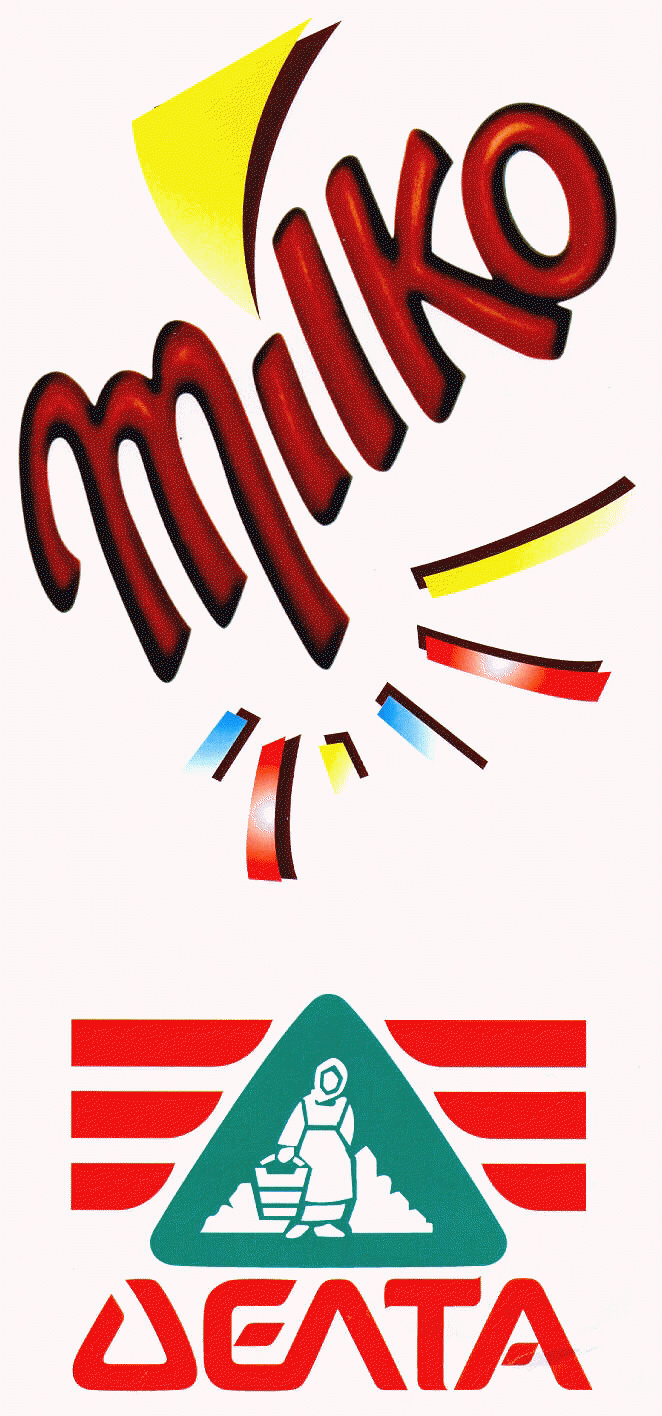
3 The goods in respect of which registration was sought fall within Class 30 of the Nice Agreement Concerning the International Classification of Goods and Services for the Purposes of the Registration of Marks of 15 June 1957, as revised and amended, and correspond to the following description: ‘milk with cocoa’.
4 The application for registration was published in Community Trade Marks Bulletin No 72/02 of 9 September 2002.
5 On 5 December 2002, the intervener, Kraft Foods Schweiz Holding AG, filed a notice of opposition, under Article 42 of Regulation No 40/94 (now Article 41 of Regulation No 207/2009), against registration of the mark applied for.
6 In support of its opposition, the intervener relied, inter alia, on the existence of a likelihood of confusion, within the meaning of Article 8(1)(b) of Regulation No 40/94 (now Article 8(1)(b) of Regulation No 207/2009), with various earlier marks, including the following Community figurative mark registered on 14 September 2000 under number 31344 (‘the earlier mark’) in particular for goods in Class 29 (‘milk and milk products’) and Class 30 (‘cocoa, chocolate, chocolate and cocoa products, bakery, pastry and confectionery products, sugar confectionery, ices’):

7 The intervener also relied on Article 8(1)(a) and (5) of Regulation No 40/94 (now Article 8(1)(a) and (5) of Regulation No 207/2009), basing its opposition on various earlier registrations.
8 By decision of 17 March 2005, the Opposition Division of OHIM upheld the opposition, finding that the conditions of Article 8(1)(b) of Regulation No 40/94 were fulfilled. The Opposition Division did not examine the grounds for refusal under Article 8(1)(a) and (5) of Regulation No 40/94, and based its decision only on the likelihood of confusion with the earlier mark.
9 On 6 May 2005, the applicant filed a notice of appeal at OHIM against the Opposition Division’s decision.
10 By decision of 8 June 2006 (‘the contested decision’), the Second Board of Appeal of OHIM dismissed the appeal on the ground that the conditions of Article 8(1)(b) of Regulation No 40/94 were fulfilled. First, the Board of Appeal found that the relevant public in relation to which the likelihood of confusion had to be assessed was composed of the average consumer in the European Union. Second, it found that account had to be taken of the distinctiveness of the earlier mark enhanced through use in the European Community. Third, as regards comparison of the goods, the Board of Appeal observed that the parties did not dispute that ‘milk with cocoa’ covered by the mark applied for was identical to the broader categories of ‘milk products’ and ‘cocoa products’ covered by the earlier mark. It also stated that ‘milk with cocoa’ was similar to the goods for which the earlier trade mark had a reputation, namely ‘chocolate and chocolate products’. Fourth, as regards comparison of the signs, the Board of Appeal first of all held that the word ‘milko’ constituted the main element of the mark applied for likely to attract attention. On that basis, it went on to find that the signs were similar phonetically and visually, notwithstanding their differences arising from the presence of the ‘ΔΕΛΤΑ’ component and the colour figurative elements surrounding the word ‘milko’. Lastly, the Board emphasised that the signs did not have any conceptual elements differentiating them which were likely to reduce their visual and phonetic similarities. It therefore concluded that there was a likelihood of confusion.
Forms of order sought by the parties
11 The applicant claims that the Court should:
– annul the contested decision;
– dismiss the opposition brought against registration of the mark applied for;
– order that the mark applied for be accepted;
– order OHIM to pay the costs.
12 At the hearing, the applicant withdrew the second and third heads of the forms of order sought, which the Court formally noted.
13 OHIM and the intervener contend that the Court should:
– dismiss the action;
– order the applicant to pay the costs
Law
Argument of the parties
14 In support of its action, the applicant puts forward a single plea in law, alleging infringement of Article 8(1)(b) of Regulation No 40/94.
15 First, it submits that the overall impression produced by the marks at issue is different. The two figurative elements of the mark applied for are presented in an equally prominent way and constitute two famous marks in Greece. In addition, the terms ‘milko’ and ‘ΔΕΛΤΑ’ are the dominant elements of the mark applied for. Lastly, regard must be had to the fact that the first term of the mark applied for, ‘milko’, is primarily a generic notion descriptive of the product ‘milk’.
16 Second, the applicant carries out a visual, phonetic and conceptual comparison of the marks at issue, and claims that there are large differences between them.
17 First of all, it submits that there are obvious visual differences between the marks at issue, in that a significant visual part of the mark applied for comprises a representation of a milkmaid in a triangle, the ‘ΔΕΛΤΑ’ component occupies 50% of the mark applied for, and the colours of the respective marks are totally different.
18 Next, in terms of phonetics, it submits that European consumers are perfectly capable of pronouncing the ‘ΔΕΛΤΑ’ component or, at least, of reading it as the Latin word ‘delta’. The overall phonetic impression of the mark applied for is therefore ‘milko ΔΕΛΤΑ’ or ‘milko delta’, and is thus different from the phonetic impression created by the earlier mark.
19 Lastly, from a conceptual viewpoint, the applicant submits that, since the term ‘milk’ is descriptive, the earlier mark does not have any further conceptual meaning. By contrast, the mark applied for contains the ‘ΔΕΛΤΑ’ component, which has a very different meaning from the earlier mark.
20 Accordingly, the applicant concludes that the overall impression created by the marks at issue is very different, and that the resemblance between them is not sufficient to give rise to a likelihood of confusion.
21 In that connection, in order to substantiate its arguments, it relies on a number of recent decisions of the Boards of Appeal of OHIM and also on Case C-106/03 P Vedial v OHIM [2004] ECR I‑9573. At the hearing, it also relied on Case T‑247/03 Torres v OHIM – Bodegas Muga (Torre Muga) of 11 July 2006, not published in the ECR.
22 OHIM and the intervener do not accept the applicant’s arguments.
Findings of the Court
23 First of all, it should be noted that, since the applicant has withdrawn the second and third heads of the forms of order sought, it is necessary to examine only the first and fourth heads thereof as set out in the application, which request that the contested decision be annulled and that OHIM be ordered to pay the costs respectively.
24 Under Article 8(1)(b) of Regulation No 40/94, upon opposition by the proprietor of an earlier trade mark, the trade mark applied for is not to be registered if, because of its identity with or similarity to the earlier trade mark and the identity or similarity of the goods or services covered by the trade marks, there exists a likelihood of confusion on the part of the public in the territory in which the earlier trade mark is protected. The likelihood of confusion includes the likelihood of association with the earlier trade mark.
25 It is settled case‑law that the likelihood of confusion on the part of the public, which is defined as the risk that the public might believe that the goods or services in question come from the same undertaking or, as the case may be, from economically-linked undertakings, must be assessed globally, taking into account all factors relevant to the circumstances of the case (Case C-39/97 Canon [1998] ECR I-5507, paragraph 17, and Case T‑104/01 Oberhauser v OHIM – Petit Liberto (Fifties) [2002] ECR II‑4359, paragraphs 25 and 26).
26 In that connection, the Community legislature has laid down, in the seventh recital in the preamble to Regulation No 40/94 (now recital 8 in the preamble to Regulation No 207/2009), that the assessment of the likelihood of confusion depends on numerous elements and, in particular, on the recognition of the trade mark on the market, the association which can be made with the used or registered sign, the degree of similarity between the marks at issue and between the goods or services identified.
27 In addition, it must be recalled that, when assessing the likelihood of confusion, the distinctiveness of the earlier mark and in particular its reputation must be taken into account. The more distinctive the earlier mark, the greater will be the likelihood of confusion. Thus, marks with a highly distinctive character, either per se or because of the reputation they enjoy with the public, enjoy broader protection than marks with a less distinctive character (Case C‑251/95 SABEL [1997] ECR I-6191, paragraph 24, and Canon, cited in paragraph 25 above, at paragraph 18).
The relevant public
28 In the present case, the protection of the earlier trade mark extends to the Community, and the goods at issue are everyday consumer goods. Therefore, the Board of Appeal is correct in its analysis that the relevant public in relation to which the likelihood of confusion must be assessed is composed of the average consumer in the European Union, which is not, moreover, disputed by the applicant.
The comparison of the goods
29 The Board of Appeal endorsed the Opposition Division’s view that ‘milk with cocoa’ in Class 30 covered by the mark applied for was identical to ‘milk products’ and ‘cocoa products’ in Classes 29 and 30 respectively covered by the earlier mark. It also held that ‘milk with cocoa’ was similar to the goods for which the earlier trade mark had a reputation, namely ‘chocolate’ and ‘chocolate products’, inasmuch as cocoa is a basic ingredient in those goods.
30 Those findings were not disputed by the applicant, as confirmed by it at the hearing.
31 Therefore, the similarity of the goods concerned need not be examined further.
The comparison of the signs at issue
32 The global assessment of the visual, aural or conceptual similarity of the marks in question must be based on the overall impression given by the marks, bearing in mind, in particular, their distinctive and dominant components. The perception of the marks in the mind of the average consumer of the goods or services in question plays a decisive role in the global assessment of the likelihood of confusion. In that connection, the average consumer normally perceives a mark as a whole and does not proceed to analyse its various details (SABEL, cited in paragraph 27 above, at paragraph 23, and Case C-342/97 Lloyd Schuhfabrik Meyer [1999] ECR I‑3819, paragraph 25).
33 In the context of consideration of the existence of a likelihood of confusion, assessment of the similarity between two marks cannot be confined to taking just one component of a composite trade mark and comparing it with another mark. On the contrary, the comparison must be made by examining each of the marks in question as a whole, which does not mean that the overall impression conveyed to the relevant public by a composite trade mark may not, in certain circumstances, be dominated by one or more of its components. It is only if all the other components of the mark are negligible that the assessment of similarity can be carried out solely on the basis of the dominant element (Case C-334/05 P OHIM v Shaker [2007] ECR I‑4529, paragraphs 41 and 42, and Case C‑193/06 P Nestlé v OHIM of 20 September 2007, not published in the ECR, paragraphs 42 and 43).
34 It is in the light of those considerations that the legality of the contested decision must be determined.
35 The marks that must be compared are the earlier mark Milka and the figurative mark applied for milko ΔΕΛΤΑ.
36 The Board of Appeal held, in paragraph 30 of the contested decision, that the overall impression of the signs was that they were similar.
37 To begin with, it should be noted that the mark applied for is composed of two components ‘milko’ and ‘ΔΕΛΤΑ’, a design representing a white milkmaid inside a green triangle against a background of red lines and coloured motifs surrounding the word ‘milko’. As regards the earlier mark, which was registered in black and white, that is composed of a single word element ‘milka’ inscribed in white letters on a dark rectangle. Because the rectangle is insignificant, the word ‘milka’ is the dominant element of the earlier mark.
38 First, as regards visual comparison, certainly the word element ‘milko’ occupies a more distinctive position in the mark applied for. That component is, first of all, clearly the largest. Next, it is located at the top of the mark applied for. It is therefore more likely to attract the attention of the relevant public and to be easily noticed and remembered. That word element closely resembles the dominant word element ‘milka’ in the earlier mark. The Board of Appeal rightly states that both marks use a similar diagonal written representation for the words ‘milko’ and ‘milka’, and that the peculiarly stylised letter ‘m’ in both components is very similar. In addition, the vowels ‘o’ and ‘a’ of those components have practically the same shape.
39 Admittedly, the mark applied for contains a number of additional elements that distinguish it from the earlier mark. However, the Board of Appeal rightly states that the figurative element, comprising a milkmaid inside a green triangle against a background of red lines, will be perceived by the relevant public as ornamental. The figurative element of the milkmaid, particularly for milk products, is not, moreover, an especially original or fanciful representation likely to attract the attention of the average consumers of the goods in question.
40 As regards the ‘ΔΕΛΤΑ’ component, that occupies a position of clearly secondary importance in the mark applied for when taken as a whole. It is located at the very bottom of the mark and is much smaller than the word element ‘milko’ and even the figurative element of the milkmaid. In addition, the ‘ΔΕΛΤΑ’ component is difficult to understand for European consumers who are not familiar with the Greek alphabet, which is an additional reason for asserting that the relevant public will focus more on the word element ‘milko’.
41 Thus, the differences referred to in paragraphs 39 and 40 above are not sufficiently great to overcome the similarity arising from the word ‘milko’. In the light of those circumstances, the Board of Appeal did not err, at paragraph 28 of the contested decision, in holding that the signs at issue were similar, when it compared them visually, taking each sign as a whole.
42 Second, as regards phonetic comparison, it should be noted that the words ‘milko’ and ‘milka’ are very similar phonetically. The addition of the ‘ΔΕΛΤΑ’ component cannot call into question that similarity. Even if the relevant public were to perceive ‘ΔΕΛΤΑ’ as a Greek word, a significant part of that public would not know how to pronounce that word, and will accordingly tend to omit it when referring to the mark applied for orally.
43 In that connection, the applicant’s submission that, if they are unable to read the ‘ΔΕΛΤΑ’ component correctly in Greek, most consumers will tend to pronounce its Latin equivalent ‘delta’ must be rejected. Such an argument is based on the premiss that those consumers are familiar with the capital letters ‘Δ’ and ‘Λ’ in the Greek alphabet. The goods covered by the marks at issue are everyday consumer goods and are therefore targeted at the general public. It must be pointed out in that regard that most European consumers do not know the Greek alphabet and that only a category of more erudite consumers would know it.
44 Therefore, the Board of Appeal’s finding, at paragraph 27 of the contested decision, that at least a significant part of the public will not pronounce the ‘ΔΕΛΤΑ’ component when referring to the signs orally, since it does not know how to, must be upheld.
45 Third, as regards conceptual comparison, the Board of Appeal correctly states that the word elements ‘milka’ and ‘milko’ are invented words and do not have any meaning in any of the official languages of the Community. Therefore, as the Board observes at paragraphs 23 and 29 of the contested decision, the relevant public will associate the word element ‘milko’ with ‘milka’ because those words do not have any meaning.
46 In addition, for non-Greek-speaking consumers, the signs at issue do not have any conceptual differentiating elements that can counteract the visual and phonetic similarities. The ‘ΔΕΛΤΑ’ component cannot have the impact that the applicant wishes to have accepted on the conceptual comparison. As has been observed in paragraphs 43 and 44 above, a large proportion of European consumers will not be able to read or understand that word written in Greek. In those circumstances, that word element cannot be regarded as introducing a new concept that the consumer will associate with the mark applied for.
47 The Board of Appeal’s finding that on an overall impression the signs are similar must therefore be upheld.
The likelihood of confusion
48 First, it is apparent from the case‑law referred to at paragraph 27 above that the high degree of distinctiveness of the earlier mark must be taken into account when assessing the likelihood of confusion. In the present case, the Opposition Division concluded, on the basis of several documents, that the earlier mark has obtained a distinctiveness enhanced through use in the European Community. At paragraph 23 of the contested decision, the Board of Appeal agreed with that assessment in so far as it relates to chocolate and chocolate products, and its assessment has not been disputed by the applicant at all. Therefore, the earlier mark must be acknowledged as having a high degree of distinctiveness in relation to those goods.
49 Second, as has already been observed in paragraphs 29 and 30 above, the Board of Appeal’s finding that the goods at issue are similar, or as the case may be, identical, has not been disputed by the applicant. In addition, it has been found that, in the light of the overall impression created by the signs at issue, those signs could be regarded as similar.
50 It follows that, in the context of the overall assessment of the likelihood of confusion, the degree of similarity of the marks at issue and the degree of similarity of the goods covered by them are sufficiently high to conclude that there is a likelihood of confusion on the part of the public between the signs at issue. In addition, in the present case, the high degree of distinctiveness of the earlier mark makes the likelihood of confusion between the earlier mark and the mark applied for even greater. Given the high degree of distinctiveness of the earlier mark in particular, the fact that the word elements ‘milko’ and ‘milka’ both incorporate the English word ‘milk’, and milk is descriptive of the goods concerned, cannot eliminate the likelihood of confusion.
51 Therefore, the Board of Appeal was correct to hold that there was a likelihood of confusion between the marks at issue.
52 That finding cannot be called into question by the arguments put forward by the applicant which make reference to a judgment of the Court of Justice and a judgment of Court of First Instance, eight OHIM decisions and one decision of the administrative trade marks committee in Greece.
53 First, the judgments on which the applicant relies are not relevant in the present case. As regards, first of all, Vedial v OHIM, cited in paragraph 21 above, the mark applied for concerned a Christian name and not, as in this case, an invented word. Similarly, Torre Muga, cited in paragraph 21 above, is clearly distinguishable from the present case in that the word element ‘torre’ of the Torre Muga trade mark applied for has a real meaning, ‘tower’ in English, and that term is currently used for alcoholic beverages covered by the application for the Torre Muga trade mark.
54 Second, the applicant’s argument based on eight OHIM decisions is irrelevant. Those decisions concern different signs and, with the exception of the two marks covering goods within Class 29, the goods covered by the marks are not the same as those at issue in the present case. In any event, the legality of the decisions of the Boards of Appeal is to be assessed solely on the basis of Regulation No 40/94, as interpreted by the Community judicature, and not on the basis of OHIM’s practice in previous decisions (see Case T‑35/04 Athinaiki Oikogeniaki Artopoiia v OHIM – Ferrero (FERRÓ) [2006] ECR II‑785, paragraph 68, and Case T‑33/03 Osotspa v OHIM – Distribution & Marketing (Hai) [2005] ECR II‑763, paragraph 69 and the case-law cited).
55 Third, as regards the decision of the Greek administrative trade marks committee, in which it was held that there was no likelihood of confusion between the Greek figurative mark ΔΕΛΤΑ milko and the Milka mark, it should be noted that the mark whose registration was accepted is different from the mark being applied for, since the components ‘milko’ and ‘ΔΕΛΤΑ’ were inverted. In addition, it should be recalled that the Community trade mark regime is an autonomous system which applies independently of any national system (Case T‑32/00 Messe München v OHIM (electronica) [2000] ECR II‑3829, paragraph 47, and FERRÓ, cited in paragraph 54 above, at paragraph 67). Accordingly, whether or not a sign is registrable as a Community trade mark must be assessed by reference to the relevant Community legislation only, so that neither OHIM nor the Community Court are bound by decisions in other Member States finding the same sign to be registrable as a trade mark (Case T‑36/01 Glaverbel v OHIM(Surface of a sheet of glass) [2002] ECR II‑3887, paragraph 34). The legality of decisions of the Boards of Appeal is to be assessed purely by reference to Regulation No 40/94, as interpreted by the Community judicature, and not to a Member State’s national court’s practice in previous decisions (Case T‑117/02 Grupo El Prado Cervera v OHIM – Debuschewitz heirs (CHUFAFIT) [2004] ECR II‑2073, paragraph 57, and FERRÓ, cited in paragraph 54 above, at paragraph 67).
56 In the light of those considerations, the single plea in law alleging infringement of Article 8(1)(b) of Regulation No 40/94 must be rejected, and, accordingly, the action must be dismissed.
Costs
57 Under Article 87(2) of the Rules of Procedure of the Court of First Instance, the unsuccessful party is to be ordered to pay the costs if they have been applied for in the successful party’s pleadings. Since the applicant has been unsuccessful, it must be ordered to pay the costs in accordance with the forms of order sought by OHIM and the intervener.
On those grounds,
THE COURT OF FIRST INSTANCE (Fifth Chamber)
hereby:
1. Dismisses the action;
2. Orders Vivartia ABEE Proïonton Diatrofis kai Ypiresion Estiasis to pay the costs.
Delivered in open court in Luxembourg on 10 June 2009.
[Signatures]